

The head of product came to marketing with a request I’d heard plenty of times: a big feature was about to ship – could we make some noise about it?
A few days later I was on a call with exactly the kind of customer we’d decided we wanted more of. A 50+ person organization, the type sitting right at the top of our shiny new ideal customer profile. I mentioned the feature, half expecting enthusiasm.
She told me it wouldn’t help her work.
Not “nice to have”. Not “maybe next quarter”. It had nothing to do with how her team used the product.
That’s when the light bulb went off. 💡 We hadn’t missed on one feature – we’d agreed on a new ideal customer and then kept building for the old one. Our ICP wasn’t a marketing problem. It was a company problem, and it had been hiding in plain sight.
🧭 How we got there
When I joined Toggl, the homepage promised “effortless time tracking for teams of any size” – then split it three ways, in case anyone missed it: for freelancers, for small teams, for large teams. (No need to look up synonyms for “everyone”.)
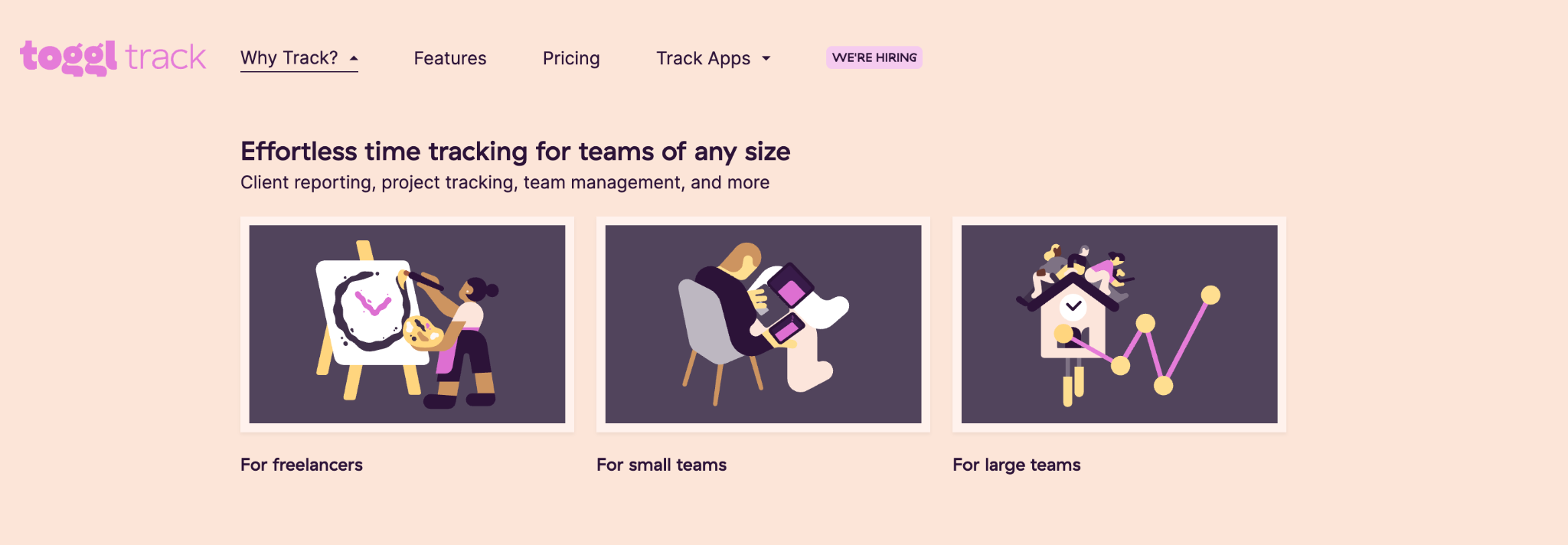
It sounded inclusive. In practice, it meant every decision – what to build, what to say, who sales should call – got made for a different imaginary customer depending on who was in the room.
The freelancer math alone should have settled it. To grow the way the business needed on freelancers, we’d have needed tens of thousands of extra customers every year – and none of the existing ones leaving. That’s not a growth plan. That’s a wish.
So our product marketer and I went back to customer research. About two months later we had an answer: agencies and professional-services firms with 50+ people, and internal teams inside large enterprises. We presented it. Everyone agreed.
And then, for about two years, not much changed.
😶 Everyone agreed. Nothing changed.
Nobody pushed back. That was the strange part. People nodded in the meeting, then walked out and proposed “feature X” for the roadmap – a feature that had nothing to do with the customers we’d just agreed on.
Nobody was being difficult. Old assumptions are sticky. When you’ve built for “everyone” for years, every request from every customer sounds equally reasonable, and the roadmap fills itself.
The big feature I was asked to promote wasn’t a mistake someone made. It was what a company without an enforced ICP builds by default.
⏳ What I think those two years cost us
This is my read, not a verdict – I can’t prove the counterfactual.
While we were busy agreeing, the tools our customers already lived in – ClickUp, Monday, Asana – added time tracking. For a lot of teams, “good enough and already inside the tool we use” beat “best-in-class but separate”. Time tracking started turning into a feature.
A company that knew exactly who it was for two years earlier would have had a much sharper answer to the question every buyer was starting to ask: “Why not use the time tracker in the tool we already have?” Agencies that bill clients by the hour have a very good answer to that. “Everyone” doesn’t.
When the ICP did take hold, growth followed. But it landed in a smaller window than it would have two years earlier.
🔧 What moved it in the end
The part I don’t see in ICP guides: nobody changed their mind in a meeting. They changed it when the systems around them stopped making room for the old customer.
Onboarding. We rebuilt it around the features our best accounts used in their trial – billable rates and advanced reporting. New users got pushed toward the behavior of the customers we wanted.
Routing. With tens of thousands of trials a month, nobody could qualify them by hand. We scored trials on firmographic and in-product signals, pulled the promising ones out of generic onboarding, and sent them to sales. Below a set size, customers bought on their own and sales stayed out.
Everything sales touched. The ICP work spread into pricing research, case studies and sales collateral. Once the case studies were about 50-person agencies, it got hard to pitch anyone else with a straight face.
None of that was me alone – it took the product marketer, the lifecycle team, sales leadership and a lot of patience from product. And it took leadership deciding the ICP wasn’t optional.
The test
If you take one thing from the Toggl story, make it this: an ICP is only real once it has changed three things – what you build, what you say, and who you say no to. If yours hasn’t touched all three, you don’t have an ICP yet. You have a document everyone agreed with.
I wrote up the full method – how to build an ICP from what your best customers did, a template, and the three-change test.
None of this is a silver bullet. Enforcing an ICP costs you deals and features you’d have liked to keep, and it takes longer than anyone budgets for. But the alternative is spending two years building for a customer who isn’t there.
Hit reply and tell me which of the three your ICP has changed so far. I read every one.
– Ilia
Oof, discontinued entirely — that's the clearest possible proof the ICP was never really there. Thanks for being candid about it, because the quiet version of this story is way more common than the postmortems admit.
This is the classic cart-before-horse problem: a feature exists, someone wants noise, and the ICP gets bolted on as justification after the fact instead of shaping the message from the start. In my experience the fix isn't a better ICP doc, it's forcing whoever requests the announcement to name the specific customer call they'd want it to win. Curious whether that call ended up changing how the feature got positioned at launch, or if the announcement had already gone out by then?